
Waves Pilates Classes, Explained

New to Pilates at Waves, or just never quite sure which class to book? Here’s a straightforward guide to how our Pilates classes are structured, what each level means, who each class is for, and how to pick the right one for you.

Mat vs Equipment Pilates: what’s the difference?

Both are Pilates, but the setting and the feel are genuinely different, and it’s one of the first questions we get from new clients. (click on each title to see the schedule!)

  • Mat classes are done on the floor, using small props like bands, balls and weights. Classes normally run up to 12 people and last 50 minutes, a great entry point if you’re new to Pilates or prefer working with your own bodyweight. Our Essentials Mat and Pre-Natal Mat classes run in smaller groups, up to 10 people, so instructors can keep a closer eye on more individual needs.
  • Equipment classes use the reformer, tower and chair, the spring-based machines Pilates is known for. Groups are smaller (max. 7), which means more individual attention per session, and the added resistance and support of the equipment opens up a different range of movement than mat work alone.

Neither is “better”, many clients do both. If you’re not sure where to start, book a free discovery call to talk it through, or an intake session if you’d like a more hands-on assessment before your first class.

General Classes: Focus, Flow & Power

These are our three general class styles, and they exist on both Mat and Equipment. Think of them as different intensities and focuses within the same class family. (click on each title to see the schedule!)

  • Focus: slower and controlled. And to be clear: slower doesn’t mean easier. Focus is about bringing real connection into the body, working with precision, and giving yourself the time and space to actually feel and internalise each movement, something becoming increasingly important in our fast-paced environments.
  • Flow: a blend of Focus and Power, with exercises linked together continuously. Good for building rhythm and body awareness once the fundamentals feel familiar.
  • Power: dynamic and more intense, combining classic Pilates movements with bigger, more challenging variations. Good once you’re comfortable with the fundamentals and want to be pushed.

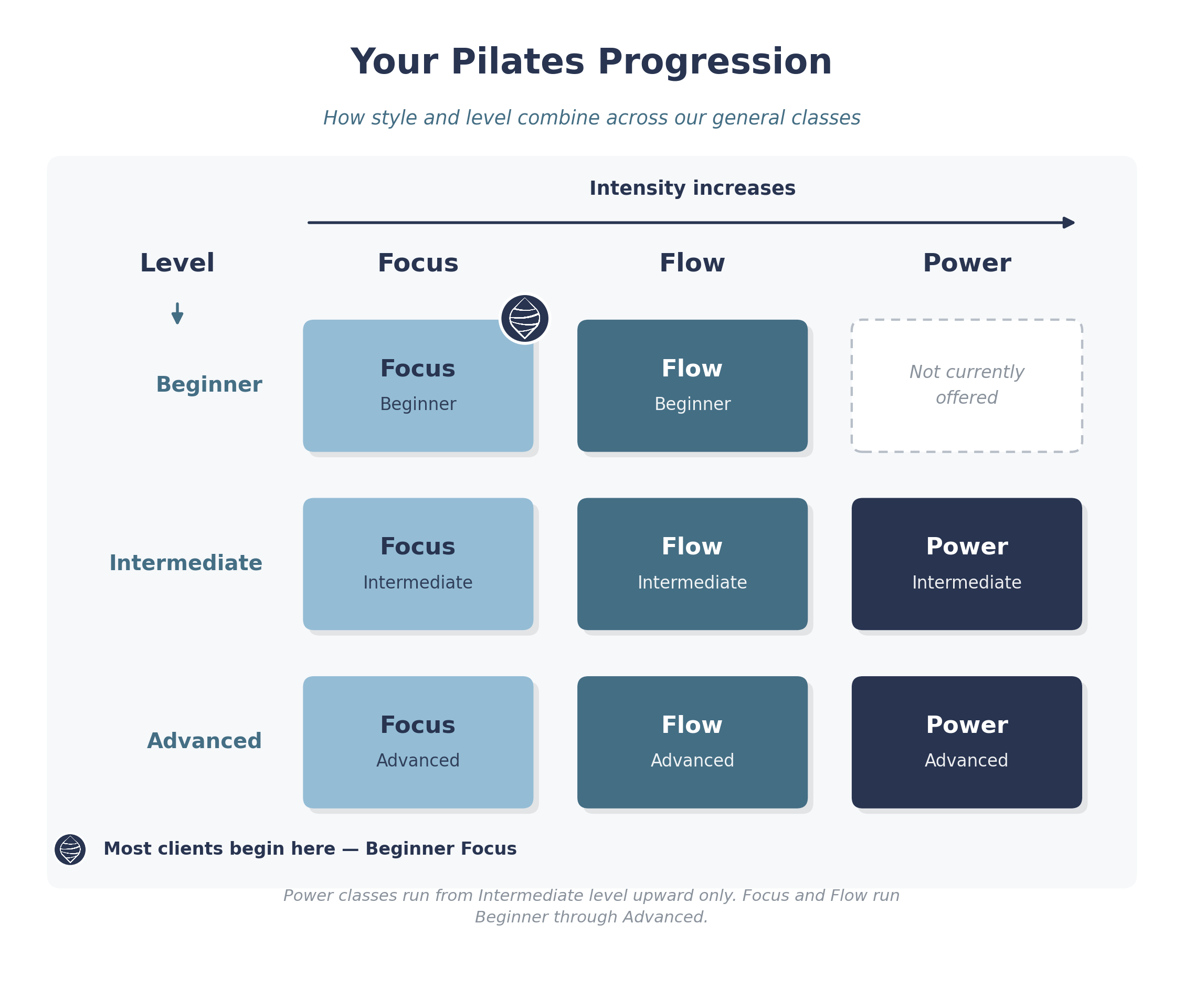
Waves Pilates class progression diagram: Beginner, Intermediate and Advanced across Focus, Flow and Power

Beginner, Intermediate & Advanced: how the levels work

On top of Focus, Flow and Power, our general classes are tagged by level. This is what tells you how challenging a given session will be, independent of which of the three styles it is:

  • Beginner: new to Pilates, or new to a particular style. The focus is on learning the vocabulary and getting comfortable with the equipment or the mat.
  • Intermediate: comfortable with the fundamentals and ready for more complexity and challenge.
  • Advanced: strong technical foundation, ready for the full range and intensity a class can offer.

One thing worth knowing: Power classes only run from Intermediate level upward, there’s no Beginner Power. Focus and Flow, on the other hand, both run right across Beginner, Intermediate and Advanced.

In practice, most people start in a Beginner Focus class, get familiar with the equipment and the core Pilates vocabulary, and then progress in two directions at once: moving up through the levels, and moving across the styles as they’re ready for more intensity. You don’t need to “graduate” from Focus to move on, plenty of experienced clients stay with Focus at a higher level because they simply prefer the style. See the diagram below for how it all fits together.

Want to see the ‘criteria’ for our clients to be able to join our Advanced Classes? Click here.

Specific Classes: built around you

Alongside the general classes, we run a set of Specific classes, built around a particular life stage, condition or goal rather than a general fitness level:

  • Essentials: for anyone with an injury or health condition who needs extra guidance. A great stepping stone into general classes, always led by a rehab professional (physio or exercise physiologist). Runs in smaller groups of up to 10.
  • Bones & Balance (Mat, Equipment or Combo): for people with or at risk of osteoporosis, focused on bone density, strength and fall prevention.
  • Pre-Natal: for expecting mums, safe and recommended throughout pregnancy. Also runs in smaller groups of up to 10 on the Mat.
  • Mums & Minis: post-partum recovery classes you can do together with your baby, from around 6 weeks post-partum.
  • Teens: age-appropriate strength and movement work for younger clients.
  • Let’s Move Neuro / Let’s Sport Neuro: small-group classes for people managing a neurological condition, run with a specialised trainer or physiotherapist.
  • Pro Equipment: an advanced class for qualified Pilates instructors only.
  • Meditation Moments: group meditation and relaxation (taught in Dutch).

If any of the above applies to you, these classes are worth prioritising over general ones, they’re led by professionals trained specifically for that population.

Not sure where to start?

That’s completely normal, and honestly the most common question we get. If you have no injuries and want to try a general class, you can simply book in, start with a Beginner Focus class if you’re unsure. If you have an injury, a health condition, or you’re just not sure which level suits you, we recommend combining two things: a free discovery call to talk through your goals and get a first steer, and an intake session (30, 60 or 90 minutes) so your programme is properly assessed and built around you from day one.

Ready to book your first class?

Also interested in Gym?

Our Gym classes follow a similar logic but aren’t identical, read Waves Gym Class Levels, Explained to see how the two connect.

SHARE

Other articles

General

Why New Habits Take Longer Than You Think

It’s not about willpower. The science behind why new movement habits take time to stick, and Katina’s own…
Read more
Gym

Waves Gym Classes, Explained

A straightforward guide to how our Gym classes are structured, what each level means, who each class is…
Read more
General, Health

Understanding Weight Management: Beyond Diet, Exercise, and Willpower

Weight management is shaped by far more than what’s on your plate or how often you train. Your…
Read more